

Cambodia
Lost in the Temples of Angkor

It was dark as we drove to Siem Reap, with the vague smell of something burning in the air. It was a familiar smell, a scent that took me back to Egypt, or to childhood trips to India. Every so often, a single motorcycle light flickered past, or a roadside stall glowed for a moment, but otherwise there was nothing to see.
An hour later, we arrived at our hotel. The staff greeted us with their hands pressed together and a slight bow, and a young woman with a smile I would remember showed us to our room. Over the days that followed, this first impression would prove true again and again. The Khmer people I met were gentle and warm, a kindness that felt all the more striking given that Cambodia had lived through one of the worst genocides of the twentieth century only a generation ago.
Siem Reap is the gateway to the ancient temples of Angkor, one of those places I had always vaguely known about, like the pyramids of Egypt or Machu Picchu. An iconic monument of the ancient world, something I probably learned about in an elementary school textbook but never really imagined I would stand before myself.
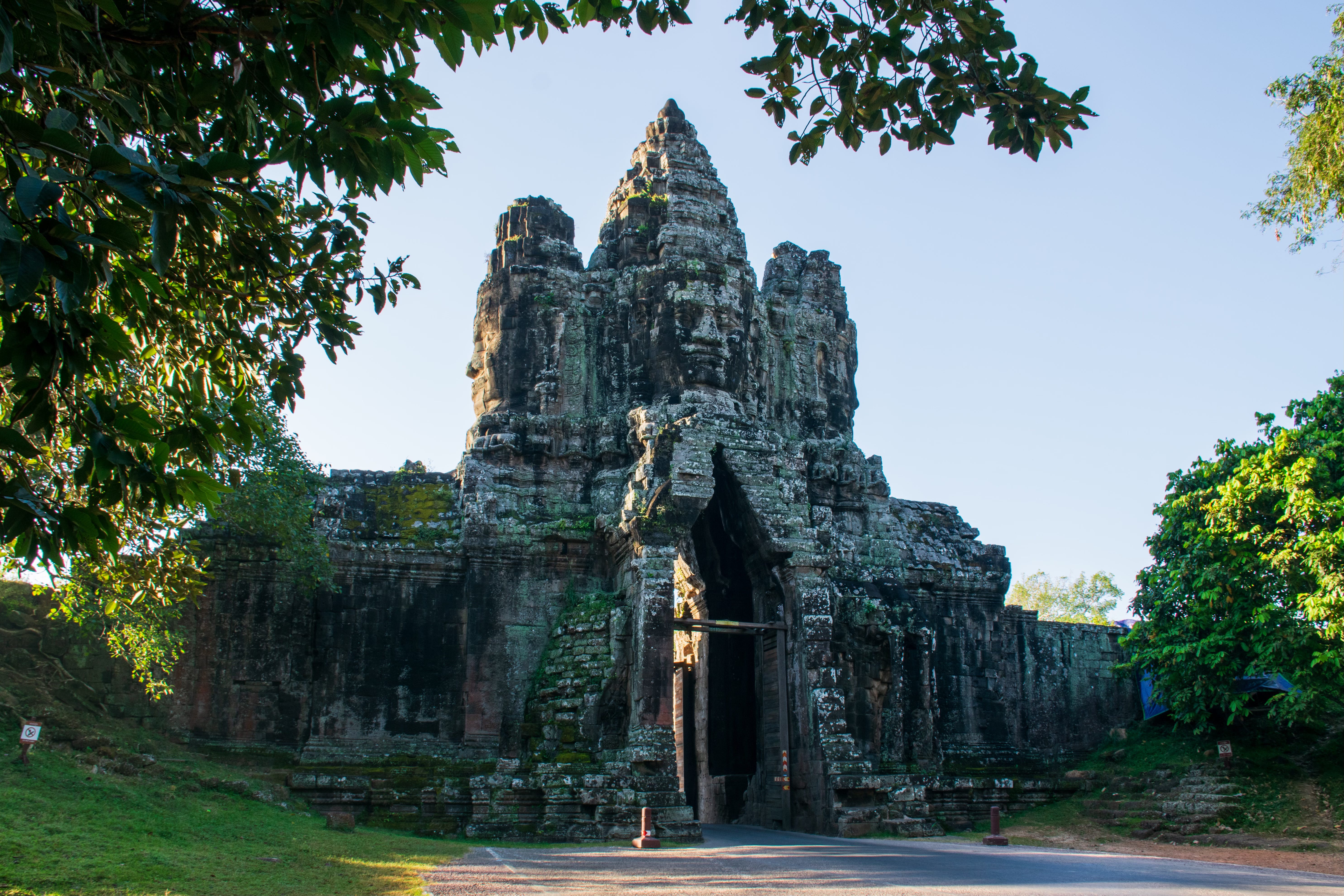
The next morning, our driver picked us up and we left the buzzing streets of Siem Reap, its dusty grid dissolving quickly into the greenery of the jungle as the road narrowed and trees pressed in from both sides. Then, almost without warning, we arrived at one of the ancient gates of Angkor Thom. Four immense faces crowned the stone tower above us, serene yet unreadable, perhaps smiling, perhaps judging.
Angkor Thom was a vast, walled capital, the heart of the Khmer Empire at its height. From the ninth to the fifteenth centuries, this empire dominated much of mainland Southeast Asia, building cities, canals, and temples on a scale that still feels improbable today. The city was laid out with intention, its avenues leading inward toward Bayon Temple at the center, where religion, politics, and power converged.
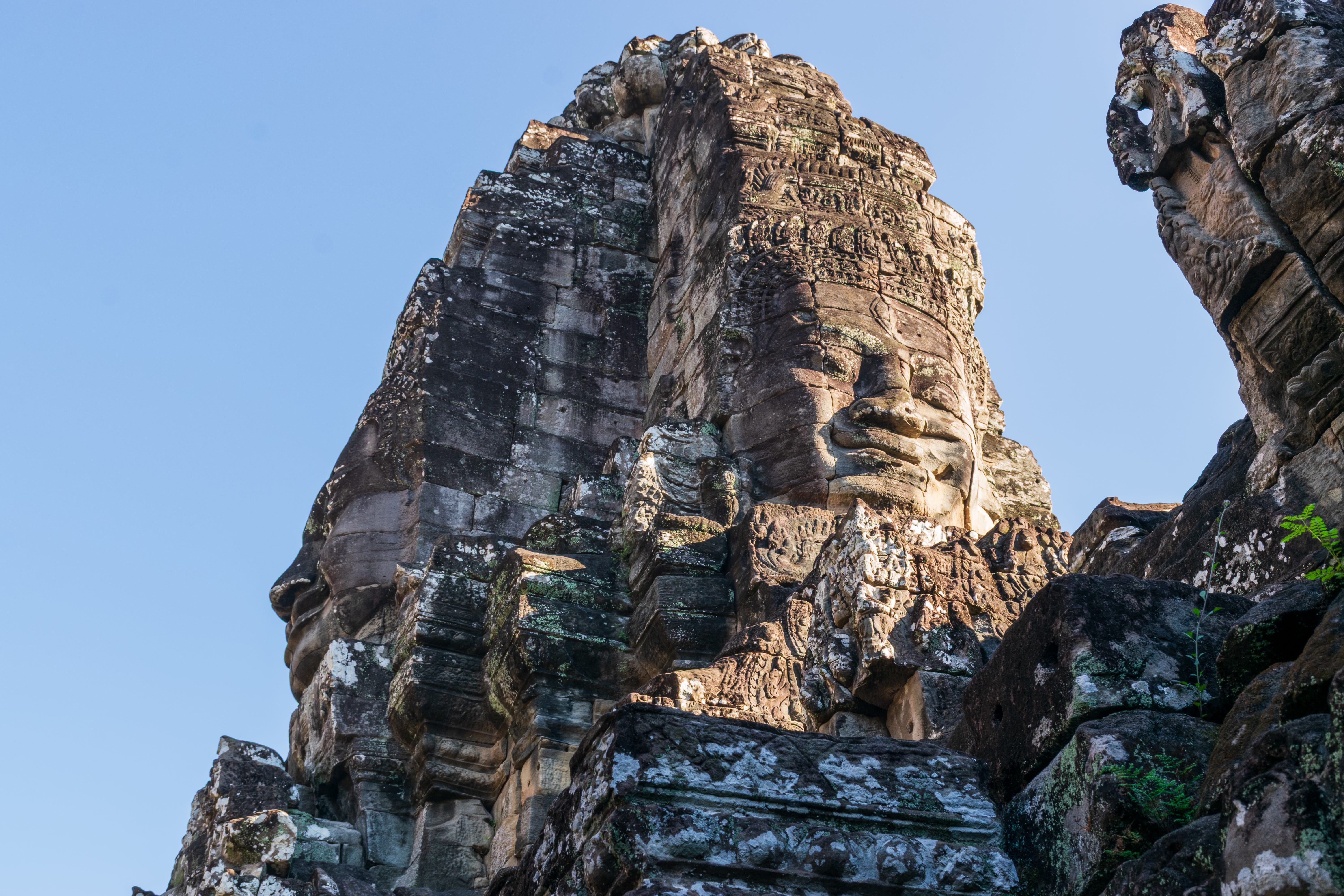
Hundreds of carved faces looked down from every direction, believed to be the likeness of Jayavarman VII fused with a bodhisattva, an enlightened being, blurring the line between king and the divine. The temple itself was a maze. We wandered through room after room, tracing inscriptions, peering into dark corners, always aware of the faces watching from above, while trying not to stumble over the uneven stone floors. A sudden burst of bats exploded overhead, disappearing into the shadows just as quickly as they appeared.
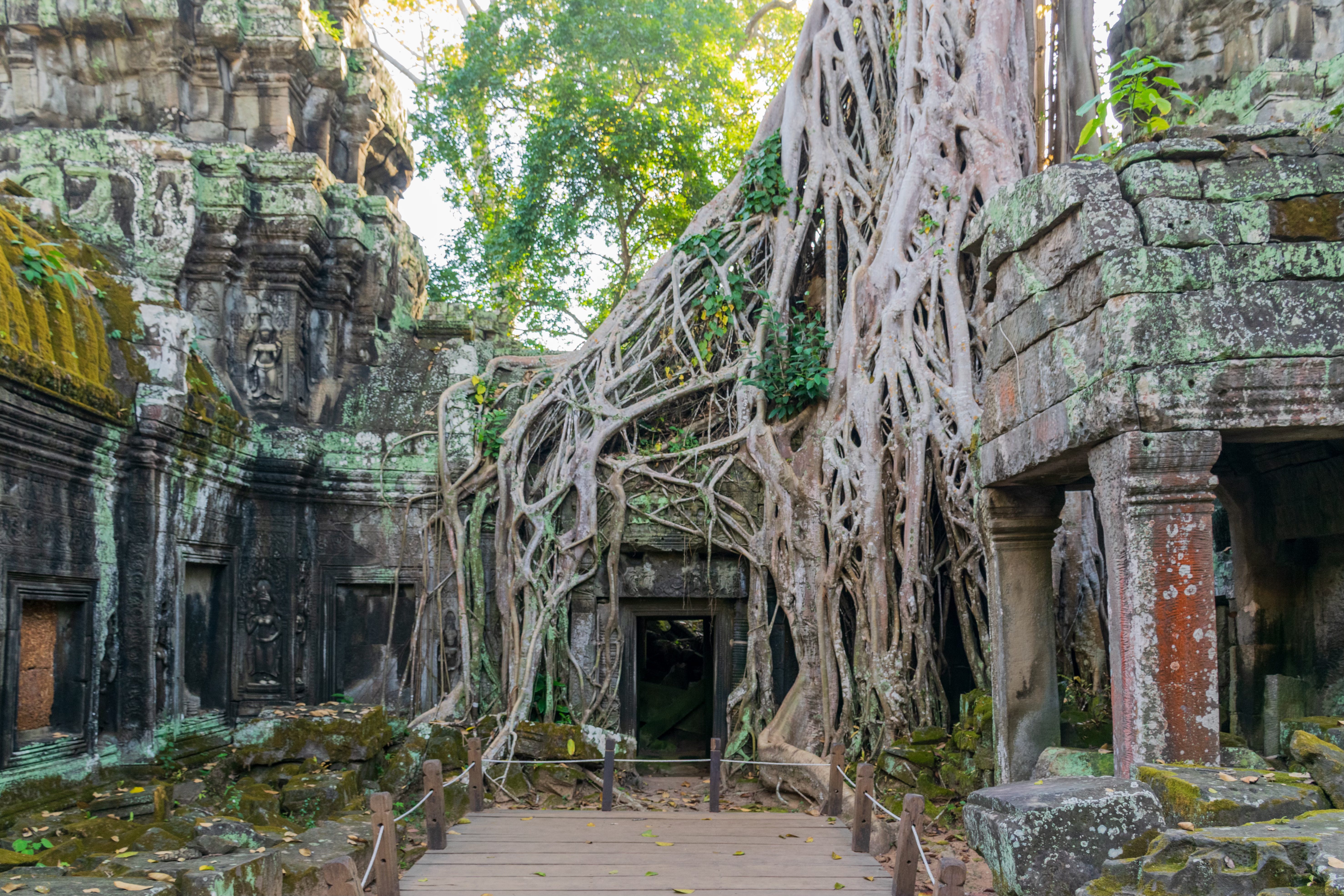
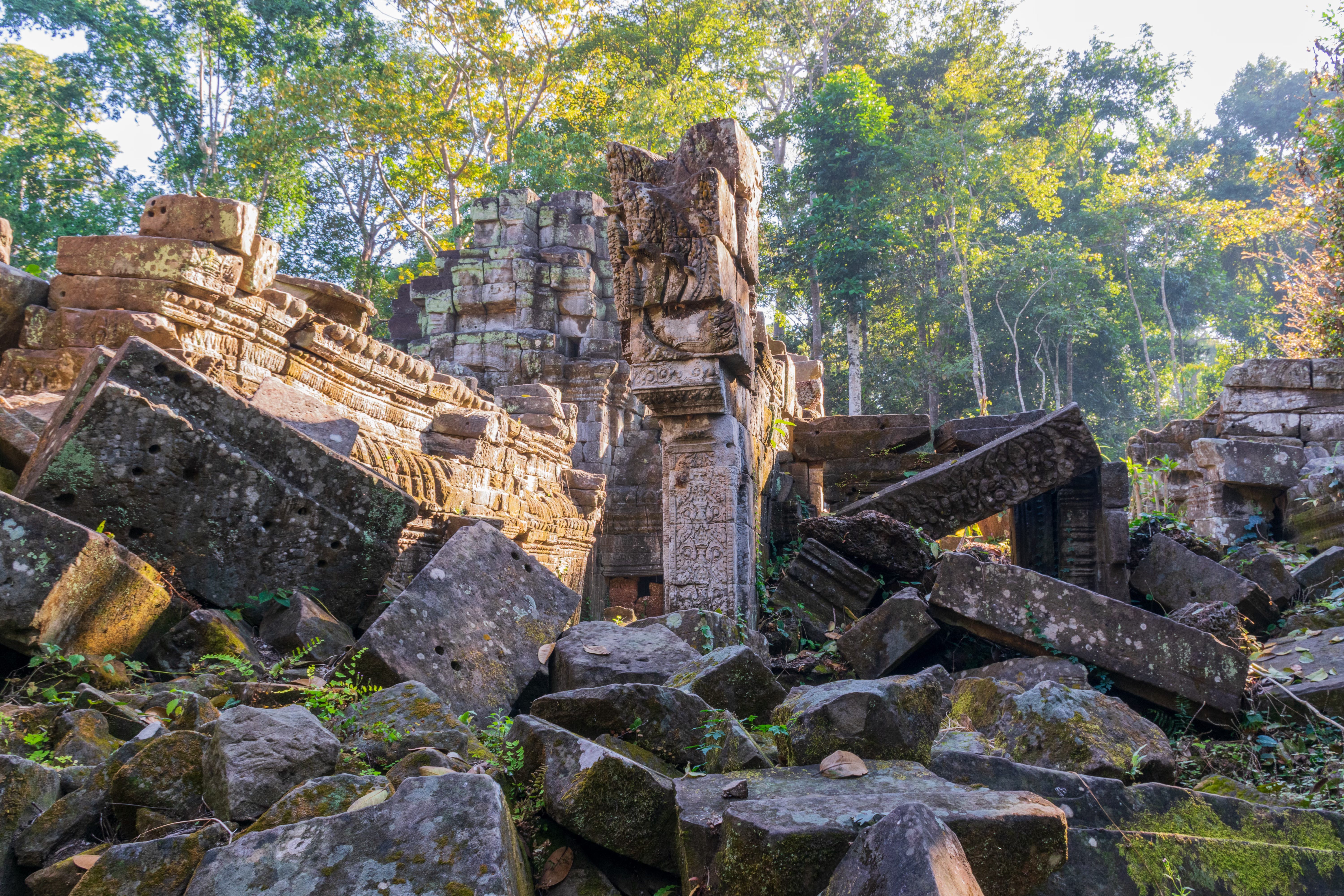
Just ten minutes away was Ta Prohm, often called the Tomb Raider Temple after scenes from Lara Croft: Tomb Raider, starring Angelina Jolie, were filmed here. Unlike many of the other temples, Ta Prohm has been left largely unrestored, its stone walls locked in a quiet struggle with the jungle. Massive tree roots spill over doorways and corridors, prying blocks apart, while piles of fallen stone lie scattered below, softened by moss
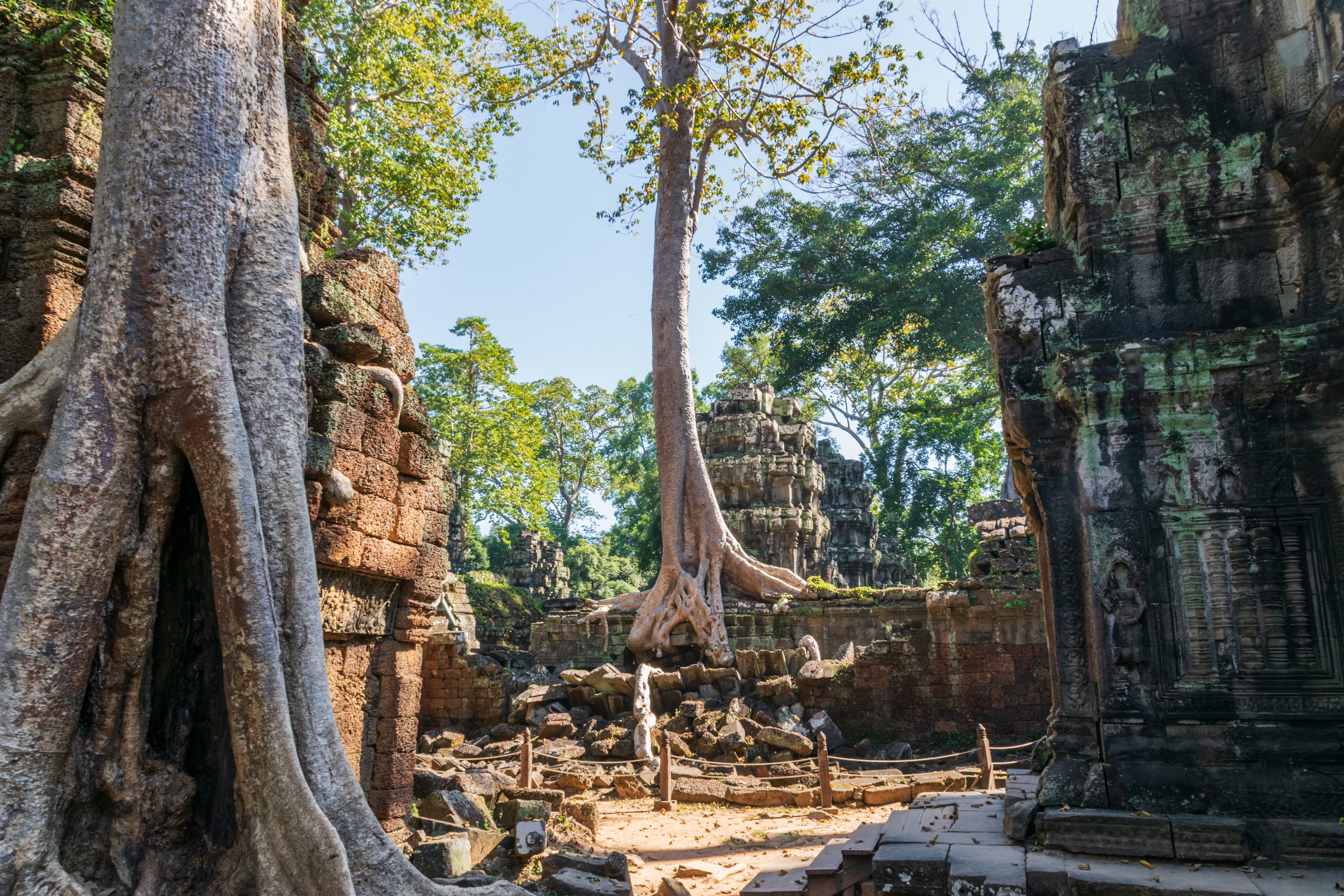
It gets very hot in Cambodia, with afternoon temperatures easily climbing past ninety degrees, the humidity making it feel worse. Tourists fall into a familiar pattern. Mornings are for exploring, afternoons for long stretches of rest, and evenings for heading back out toward sunset. After resting through the worst of the heat, we set out for Pre Rup, a tenth-century Hindu temple catching the fading light with a copper glow as we arrived.
Pre Rup is a mountain-temple, built as a symbolic representation of Mount Meru, the center of the universe in Hindu cosmology. Its steep tiers rise above the surrounding jungle, forcing you upward rather than inviting you in. We climbed the impossibly steep and large steps to the top of the temple. It was a pinch-me moment, standing on a thousand-year-old Khmer temple at sunset. We made a small circle around the summit before sitting on the steps, watching the sun drop behind the jungle as bats flew in the distance.
The next morning, when we entered the complex of Angkor Wat, it was still dark. Above us were the lights of the constellations, and below, the glow of tourists’ cell phones as people felt their way along the path. I had no idea where we were walking. At some point we passed a small temple, then kept going until the ground opened up and a reflecting pool appeared ahead of us. This was where the towers would finally reveal themselves as the sun rose.
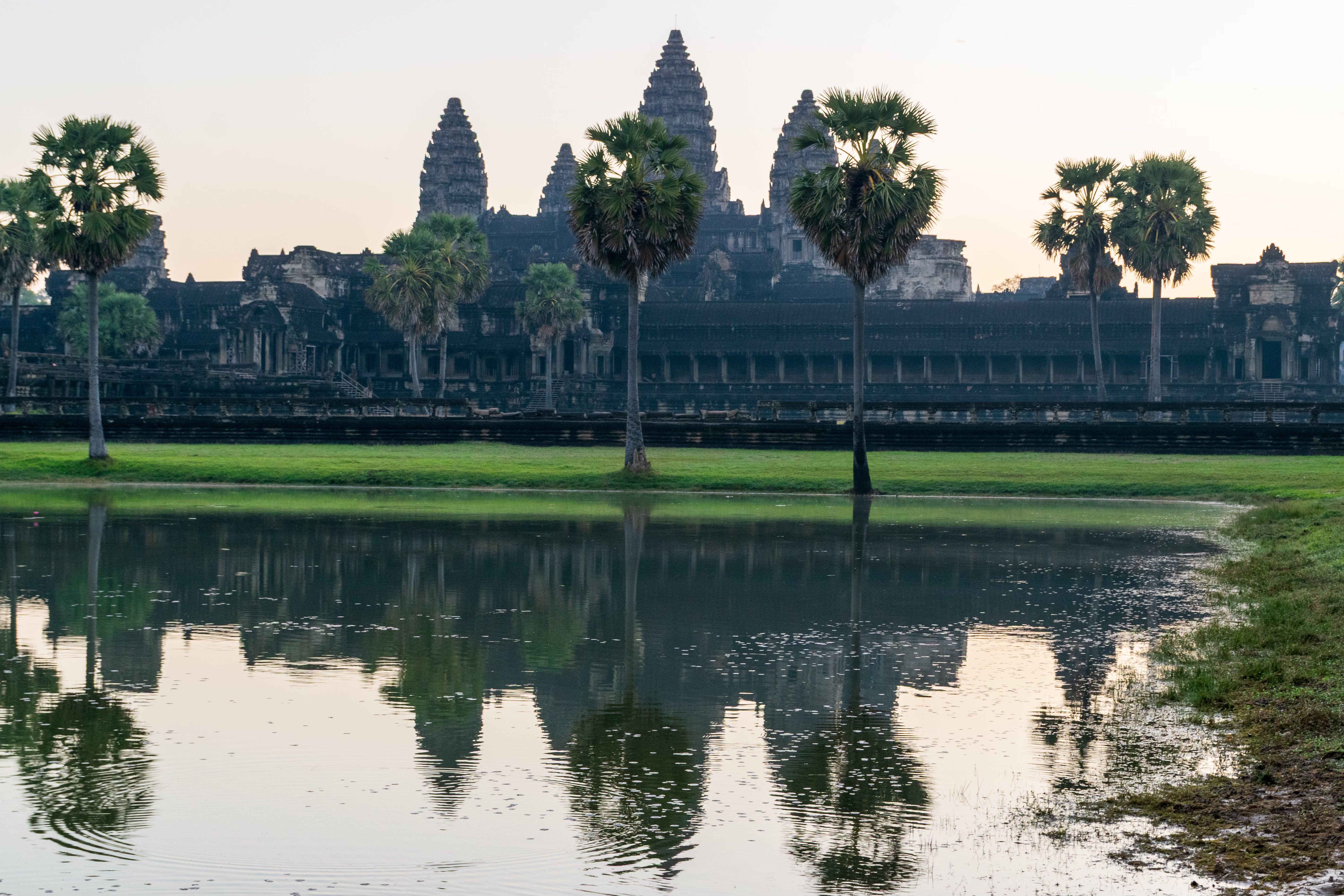
This wasn’t a sunrise you experienced alone. Hundreds of other visitors staked out their patches of ground, waiting quietly for first light. And yet, there was something communal about it, watching dawn break together over one of the wonders of the world. Slowly, the sky softened into shades of orange and purple, and the towers of Angkor Wat, along with the surrounding palm trees, appeared in the water.
Angkor Wat was an engineering marvel. It was built at the center of a vast, man-made landscape of reservoirs, canals, and moats designed to control water on a monumental scale, storing it during the monsoon and releasing it through the dry season. This hydraulic system supported a city of hundreds of thousands and allowed Angkor to flourish where it otherwise should not have.
When the Khmer Empire declined, the jungle slowly took over, swallowing roads, walls, and entire neighborhoods. Angkor Wat itself was never fully abandoned, remaining a working religious site, but much of the surrounding city faded from view. It was only in the nineteenth century, when European travelers and explorers encountered the ruins again, that Angkor reentered the global imagination, astonishing the outside world with its scale and sophistication.
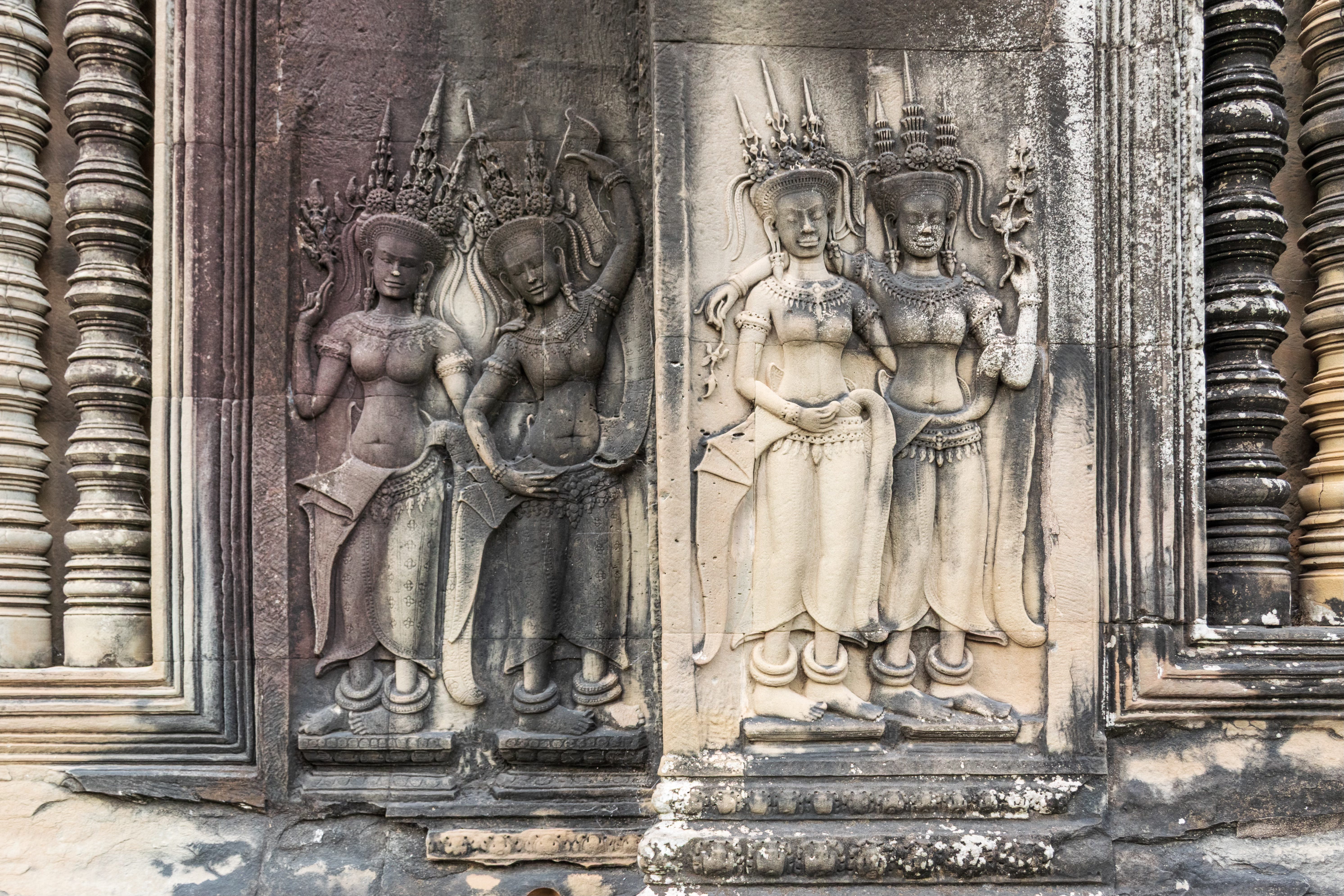
We eventually made our way inside Angkor Wat, and the scale immediately overwhelmed me. The other temples of Angkor felt small by comparison. This is, after all, the largest religious structure in the world. Room after room opened up, each lined with intricate carvings and vast stone chambers. The carvings here were the most detailed and best preserved we had seen anywhere in the complex, and there were inscriptions in the ancient Khmer script that reminded me of Elvish from The Lord of the Rings. It might be the most beautiful written language I have ever seen, delicate and impossibly graceful.
We slowly made our way to the top of the temple, breathless from the exertion. Even early in the morning, I was dripping with sweat. It was worth it for the views over the jungle and the surrounding complex, especially in the soft morning light.
We explored the smaller temples of Ta Som and Preah Khan, each just as impressive as the others. I can’t quite articulate how, but every temple here feels unique in its own way, each beautiful, even as I started to run out of adjectives to describe them. By 9:15, what felt like a full day had already passed, and we were back at the hotel eating breakfast. Outside, as the heat settled in and tourists retreated indoors, the taxi drivers gathered at a nearby compound, setting up a game of volleyball.
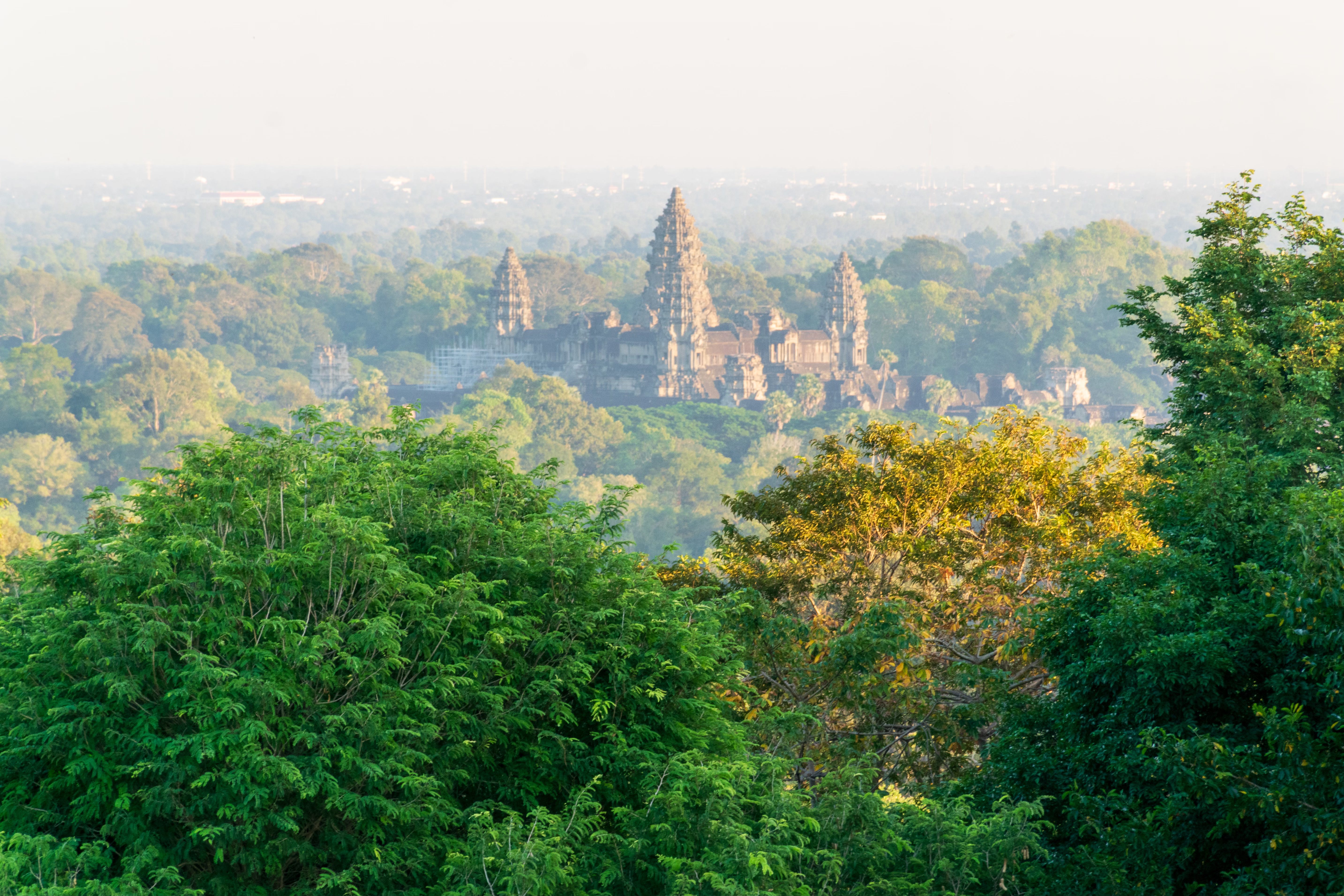
We set out once more for sunset, passing locals stretched out in hammocks at the edge of the jungle, street dogs darting across the road, and scooters carrying entire families, infants balanced carefully in their mothers’ arms. We climbed the hill at Phnom Bakheng, following a winding trail up the hillside to a late ninth-century Hindu temple built nearly two centuries before Angkor Wat. From the top, Angkor Wat appeared in the distance, its towers rising from the jungle against a hazy sky.
Nearby, the smell of incense drifted through the air. I turned, lit a stick, and left a small donation. I wasn’t praying for anything. I was saying thank you to whatever higher power had allowed me to see the world and live out dreams I once only imagined.
Ahhh this is unreal. The way you described the faces watching from every direction actually gave me chills. It sounds beautiful but also slightly eerie but in a good way.
Did it feel peaceful being there, or more intense than you expected?
Useful article